
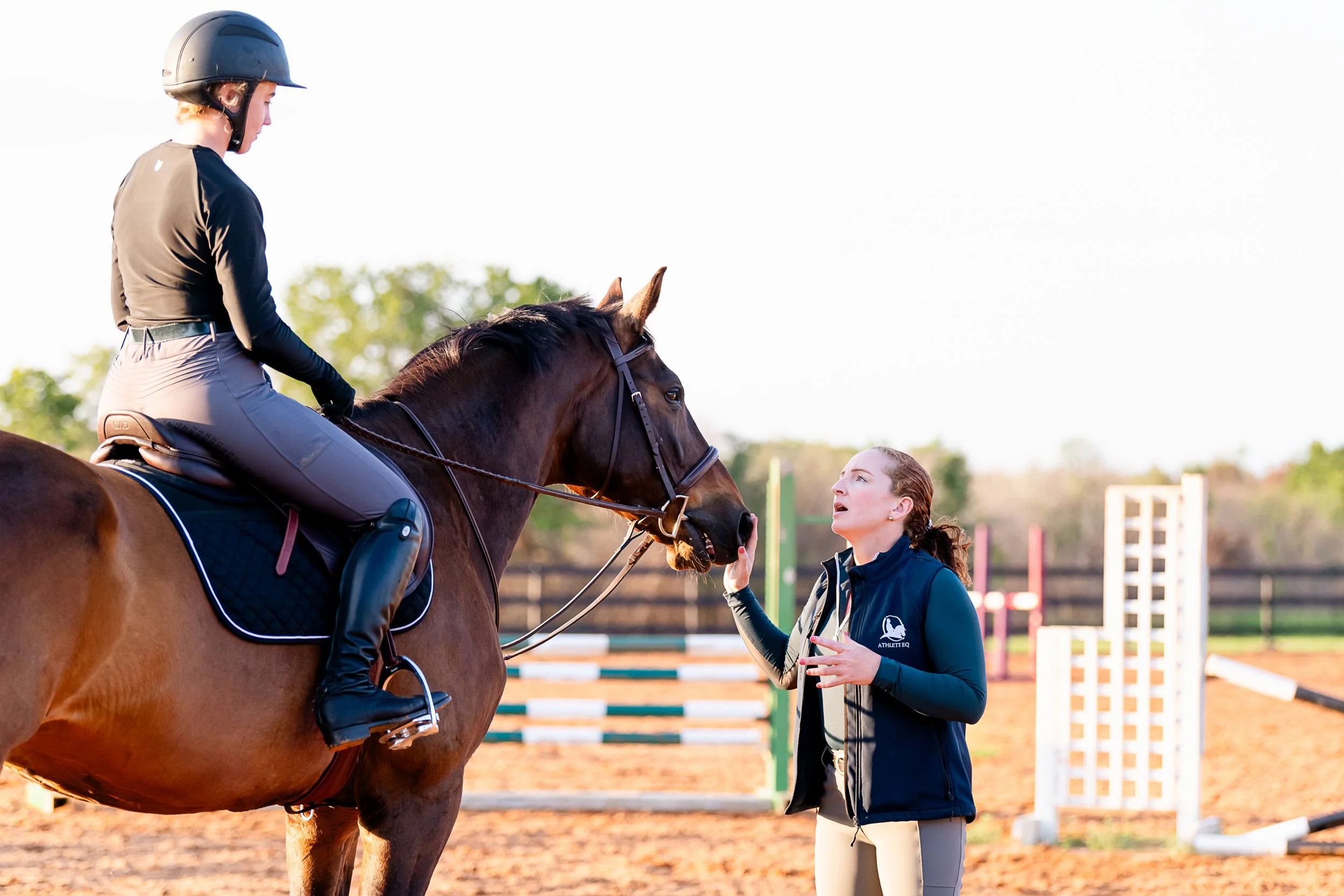
Our Trainer - Jessica Circe
Whole Heart Equestrian was built on a simple belief: how you show up matters. And that belief starts with me.
As the head coach and trainer at Whole Heart Equestrian, my role goes far beyond teaching riders how to jump higher or ride more accurately. My responsibility is to develop thoughtful, capable horsemen and horsewomen — riders who understand not just what to do, but why they’re doing it.
I believe:
Every ride is a training ride.
Horses deserve clarity, consistency, and fairness.
Confidence is built through preparation — not pressure.
The best results come from building true partnerships between horse and rider.
My coaching is grounded in progressive fundamentals, horse-and-rider biomechanics, and developmental frameworks that support both learning and performance. I care deeply about developing riders who can think, adjust, and advocate for their horses — whether schooling at home or walking into the show ring.
My coaching is grounded in progressive fundamentals, rider biomechanics, and an intentional warm-up framework that supports both learning and performance. I care deeply about developing riders who can think, adjust, and advocate for their horses — whether schooling at home or walking into the show ring.
You can expect structure.
You can expect honesty.
You can expect support.
And you can expect to be challenged — in the best way.
Whole Heart Equestrian isn’t about chasing quick results. It’s about building partnerships that last.
My Coaching Philosophy
At Whole Heart Equestrian, we believe great riding starts with great humans.
Yes, we teach technical skills. Yes, we care about performance. But our work goes deeper than that. We are here to develop whole-hearted equestrians — riders who understand themselves, respect their horses, and take responsibility for every interaction they have in the barn.
Horsemanship is not just about what happens in the saddle. It is about how you show up.
-
There is a difference between teaching and coaching.
Instruction is about learning skills — how to steer, how to balance, how to jump, how to stay safe. Coaching is about learning to think — how to solve problems, how to manage nerves, how to reflect, and how to take ownership of your decisions.
Both matter.
When a rider is learning something new or when safety is involved, I am direct and clear. As riders grow, I shift toward asking questions, encouraging reflection, and helping them make their own decisions. Research shows that when athletes are given ownership and responsibility, they build stronger confidence, motivation, and long-term commitment to their sport¹.
My goal is not to create riders who depend on me for every answer. My goal is to develop riders who can think, adjust, and lead — both for themselves and for their horses.
-
At Whole Heart Equestrian, we hold one foundational belief:
Every person who works with a horse is training that horse.
Whether you are grooming, leading, tacking up, or riding, you are teaching the horse something. Horses are always learning. That means every interaction matters.
Equestrian research consistently shows that rider behavior, emotional regulation, and consistency directly influence horse welfare and performance³. Learning, welfare, and performance are inseparable.
Because of that, we expect riders to act with awareness, fairness, and accountability. Our horses deserve that.
-
Effective equestrian coaching — and effective horsemanship — rests on three pillars:
Intentionality
We do things on purpose. We ask why. We reflect.Adaptability
There is no cookie-cutter rider or horse. We adjust to the individual in front of us.Ethical Accountability
We recognize our influence. We use it responsibly.Performance matters. But performance that comes at the cost of wellbeing, integrity, or growth is not success here.
-
We do not chase perfection. We pursue progress.
Becoming a whole-hearted equestrian is a long-term journey. It requires curiosity, self-awareness, and the willingness to evolve. Riders who learn to think, take responsibility, and care deeply for their horses build partnerships that last.
At Whole Heart Equestrian, we are not just building riders.
We are building thoughtful horsemen and horsewomen who will shape the industry for the better. -
Mageau, G. A., & Vallerand, R. J. (2003). The coach–athlete relationship: A motivational model. Journal of Sports Sciences, 21(11), 883–904.
Deci, E. L., & Ryan, R. M. (1985). Intrinsic motivation and self-determination in human behavior. Plenum Press.
Hausberger, M., Roche, H., Henry, S., & Visser, E. K. (2008). A review of the human–horse relationship. Applied Animal Behaviour Science, 109(1), 1–24.